
Direct Metal Laser Sintering (DMLS) is one of the most familiar terms in metal 3D printing, but the phrase itself doesn’t perfectly describe what occurs during the actual process. “Powder bed fusion” is the broader and, technically, more accurate description.
That distinction might seem like a small detail, but it helps clarify what is actually happening inside the machine. Understanding how powder bed fusion works shows both what makes the technology so exciting and why successful production requires designing around the process from the beginning.
Overlapping Terms for Similar Processes
In metal additive manufacturing, DMLS and powder bed fusion are often used to describe the same general process. DMLS started with EOS, one of the industry’s best-known equipment manufacturers. (We have a fleet of advanced EOS DMLS machines in our shop.)
DMLS is now used informally across the industry as shorthand for metal laser powder bed fusion; it’s somewhat similar to someone asking for a “Kleenex” instead of a “facial tissue,” although DMLS is still an EOS trademark.
But clarifying the terminology is useful because understanding the process itself leads to better manufacturing decisions. When engineers know how a part is built and why that makes orientation, heat, supports, and post-processing important, they’re better able to create a successful design.
Why “Powder Bed Fusion” Is the Better Description
Powder bed fusion is the broader category, while “laser powder bed fusion” specifically is closest to DMLS. It describes the process of using a laser to fuse metal powder one layer at a time.
During powder bed fusion, a thin layer of metal powder is spread onto the build platform. A high-powered laser selectively melts the material according to the part’s digital design. The platform then lowers, another layer of powder is applied, and the process repeats until the part is complete.
DMLS includes “sintering” in its name, but that’s something of a misnomer; the process does not sinter particles together in the conventional sense. Instead, the laser supplies enough energy to melt and fuse the metal powder into a dense component.
How a Thrilling Process Creates New Possibilities
To us, the science behind the melting and fusing is truly astounding.
For instance, the laser directs an extraordinary amount of energy into an extremely small area, with a power density that can be many times greater than the energy intensity at the sun’s surface. Even after years of working with this technology, we’re still amazed by the ingenuity that has allowed this level of energy to be used in building precise metal parts.
Powder bed fusion gives engineers opportunities to produce geometries that would be extremely difficult or impossible to machine conventionally, including:
- Organic shapes
- Internal channels
- Consolidated assemblies
- Lightweight structures optimized around performance
Conformal cooling channels are one example. Instead of being limited to straight drilled passages, designers can create cooling channels that follow the shape of a component. The same principles lead to other useful internal features like conformal gas lines.
Thinking Through Design from the Start
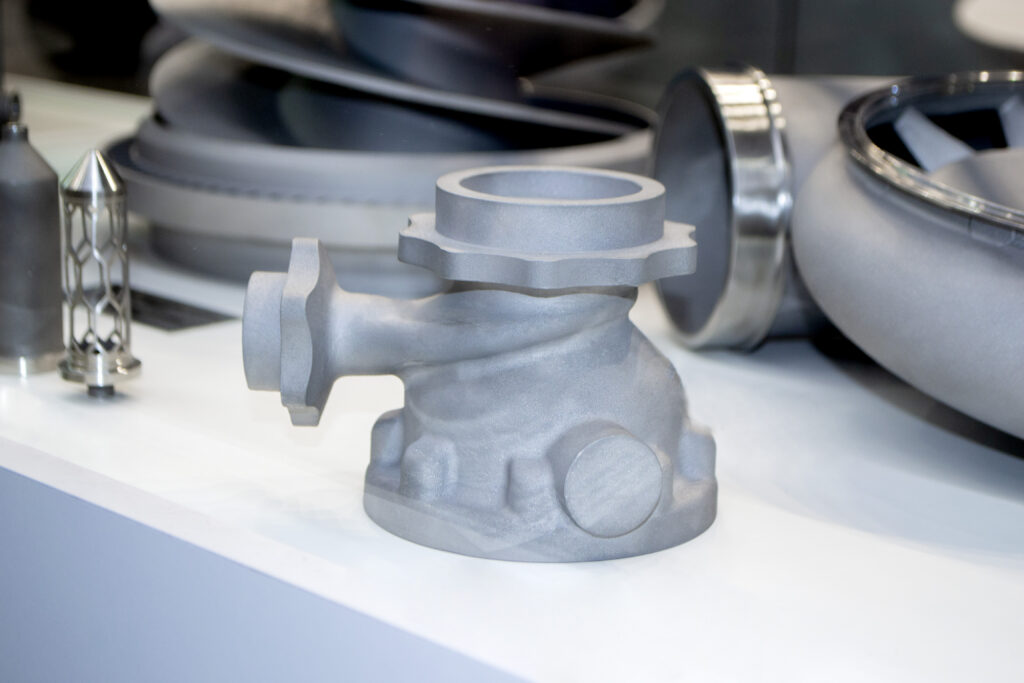
Powder bed fusion expands what is possible and eliminates many of the constraints of traditional machining, but customers have to design around this process to maximize efficiency. That’s especially important for the production-level work we offer at i3D MFG.
Part orientation, thermal behavior, support requirements, surface finish, tolerances, and post-processing must all be considered during development.
Supports, for instance, are especially important when planning for production. In prototyping, it may be possible to use extensive supports and specialized manual removal techniques. However, if removing those supports requires hours of difficult work per part, the same strategy won’t work at production volumes.
Expertise Creates Production Efficiency
At i3D MFG, understanding distinctions like DMLS vs. powder bed fusion is part of our deeper expertise in how additive manufacturing processes work in practice. Through Design for Additive Manufacturing (DFAM), we apply that expertise to each project, offering tailored recommendations that can help customers avoid unnecessary costs and lead-time challenges as production volumes increase.
If you’re considering powder bed fusion for a production application, contact i3D MFG to discuss your design!