
At i3D MFG, we’re always ready to help customers find efficient ways to utilize additive manufacturing. Additive manufacturing is now a practical production tool that has a wide variety of use cases. Manufacturers today need to identify where this powerful technique can fit alongside traditional processes to improve speed and manage costs.
Learn four ways additive manufacturing can play a strategic role in a diversified manufacturing approach.
Additive Excels When Part Complexity Increases
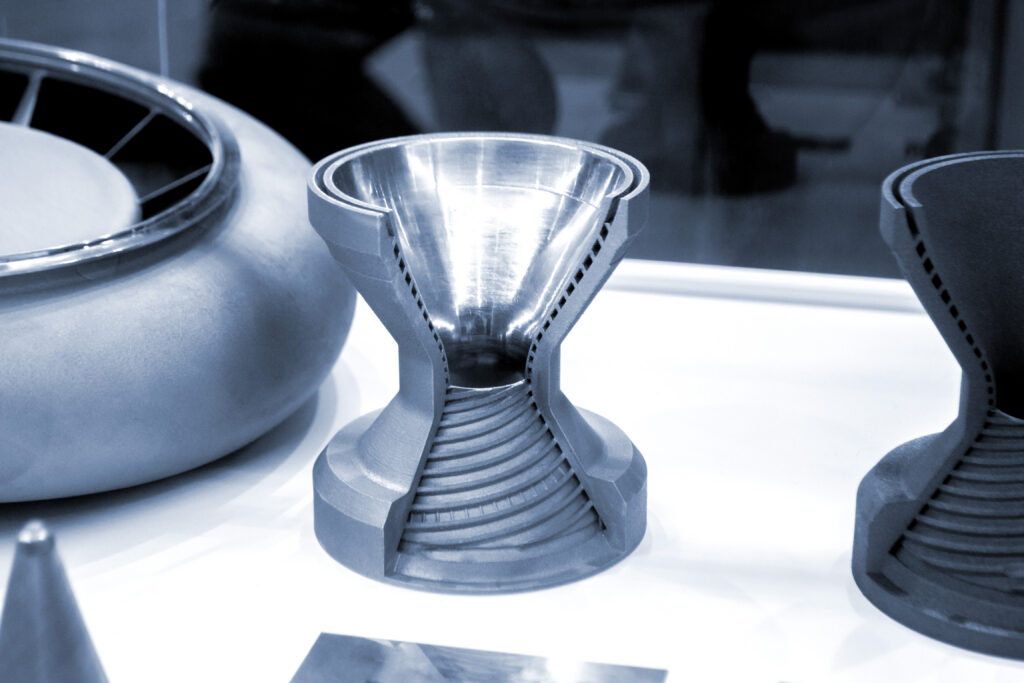
One of the clearest advantages of additive manufacturing is its ability to produce complex geometries. With conventional manufacturing, increases in complexity typically lead directly to increases in price. But intricate features or shapes that would otherwise require several processes can often be manufactured more efficiently with 3D printing techniques like Direct Metal Laser Sintering (DMLS).
That becomes even more important when expensive materials are involved. If you’re machining a part, a large percentage of the starting stock will end up as chips on the floor. That waste can have a significant impact on part costs with materials like nickel superalloys or titanium. But additive manufacturing can reduce waste and improve material utilization, in many cases making high-value parts more economical.
Agility and Optionality, Even Into Production
Additive manufacturing also plays an important role in product development and early production because it lets manufacturers be far more agile.
In many cases, it allows engineering teams to move through design iterations much faster than they could with methods like casting or molding. Traditional casting can require long lead times, sometimes stretching to several months. With additive, companies can get through multiple rounds of iteration in that time.
For instance, a large aerospace customer recently partnered with us for an early batch of a new part that was ultimately intended for casting. They needed to iterate quickly, and they saw 3D printing as the most effective option.
After seeing the quality additive manufacturing could achieve for the part, the customer realized they could begin to scale while retaining the agility they needed. They placed more orders with us, capitalizing on the benefits of additive manufacturing with the option of moving to casting down the line.
Improving Speed to Market in a Changing Industry
Today’s marketplace is more competitive than ever, and that’s why speed to market has become so critical. Delays in iteration or production can slow down growth and create opportunity costs that far outweigh the price of an individual part.
Metal additive manufacturing helps companies move forward without waiting for a traditional process. And as technology like AI potentially accelerates design and decision making in the years ahead, the speed advantage of 3D printing may become even more valuable.
Stronger Supply Chains to Minimize Risk
The manufacturing industry has seen uncertainty and volatility in recent years, and the importance of domestic suppliers has grown. Domestic additive manufacturing offers a way to reduce dependence on distant suppliers and derisk your supply chain.
Global supply chains still offer significant value, but domestic 3D printing gives manufacturers a flexible, agile partner when responsiveness is most important.
Choose the Right Process
Additive manufacturing gives manufacturers a strategic option when speed, complexity, material efficiency, or supply chain flexibility matter most. The strongest manufacturing strategies will incorporate it alongside traditional methods and choose the right process for each part and project.
Request a quote today to see whether our metal 3D printing services are the right fit for your next part or project!